

 pageviews
Okay, so he's not actually my Congressman, I'll admit it. And he's not technically a rocket scientist, either, just a nuclear physicist who served for a few years as the head of the Nuclear and Scientific Division of the Office of Strategic Forces at the State Department.
But Rush Holt is pretty smart. And pretty experienced. And he'd make a damn good Chairman of the Intelligence Committee.
For those of you who haven't been following the drama, Congresswoman Pelosi has held back on revealing her choice for the position, long after she revealed her picks for other top posts. Her hesitancy, it seems likely, comes from the fact that she has a difficult decision to make. The most obvious choice (and current senior Democrat on the Committee), Jane Harman (D-CA) is an unlikely pick, given her poor relationship with Nancy Pelosi, as well as her general complacency when faced with Republican and White House demands over the past few years.
The next ranking Democrat-- Alcee Hastings (D-FL)-- is a similarly troubling nominee. Though he has served ably on the Intelligence Committee in recent years, he has more than a few skeletons in his closet. For a Democratic Party that was handed its majority based mostly on frustration with Republican corruptness, his indiscretions might simply be too much to overlook. Twenty-five years ago, then federal judge Hastings was impeached by the Democratic House on charges of perjury and bribery, and then removed from his office by the Democratic Senate. It is interesting to note that a younger Congresswoman Pelosi was one of the House Democrats who voted to impeach Mr. Hastings.
Given the two most senior choices are so ill-suited to chair the committee, I-- and many others in the liberal blogosphere-- feel it is time for some out of the box thinking.
The first name that comes to mind is Congressman Rush Holt (D-NJ). He is exceedingly qualified, intelligent, and has a record of standing strong against Bush's Republican party. Perhaps more importantly, as David Corn points out on his blog at The Nation, "this would be a change for Pelosi to send a signal: the Democrats do regard national security seriously and are willing to put aside political concerns to do the right thing. She would be saying, merit matters most when it comes to protecting the United States."
That seems like a pretty good message to send.
So, personal opinions aside-- I am, admittedly, a big fan of Rush's-- Congressman Holt would be an excellent choice for the Chairmanship. He is both an exciting (the Rocket scientist joke never gets old) and responsible choice, and Congresswoman Pelosi should think long and hard before giving the job to anyone else.
Ok, so I'm gonna update everyone here about Ann Coulter's weekly rants in what she calls her "column," because if we are to fight the right, we have to know how they rant.
So, Ann Coulter's latest shriek is about the absolute stupidity of Muslims believing that boycotting an airline for discriminating against their right to freely worship will do damage to the airline.
Six imams removed from a US Airways flight from Minneapolis to Phoenix are calling on Muslims to boycott the airline. If only we could get Muslims to boycott all airlines, we could dispense with airport security altogether.What an intriguing notion! If we dispense of airport security, then white guys like Timothy McVeigh and Richard Reid can blow us up, and you know how safe I feel knowing that white guys kill little innocent babies.
Witnesses also said that the imams were talking about Saddam Hussein, and denouncing America and the war in Iraq. About the only scary preflight ritual the imams didn't perform was the signing of last wills and testaments.Wow, what an indictment! Denouncing America and the War in Iraq, that must mean you're a terrorist. I mean, just how many people on Earth criticize this war. I mean, Senator Chuck Hagel, a Republican of Nebraska, was calling for a pullout from Iraq yesterday in the Washington Post, and called the President "arrogant." He should pull out a last will and testament, start praising Allah, and set off his C4 on his belt already, that dastardly terrorist who served and bled in Vietnam.
More from Queen Anne:
One of the stunt-imams in US Airways' advertising scheme, Omar Shahin, complained about being removed from the plane, saying: "Six scholars in handcuffs. It's terrible."Thank you, Anne, your enlightening insights into security policy have truly given me a whole new perspective on terrorism and homeland security. I mean, you've convinced me that we should allow torture, set up secret prisons in Eastern Europe to detain people who may have been suspected of stealing bubble gum in 4th grade, round up people who believe in their One, true God, eavesdrop on American citizens without a warrant, take library records with no legal authority, and start unnecessary wars that screw up the world.
Yes, especially when there was a whole conference of them! Six out of 150 is called "poor law enforcement." How did the other 144 "scholars" get off so easy?
If we do all that, we'll be safe from the terrorists. read more...
You rarely see the name “Hillary Clinton” without the phrase “frontrunner for the 2008 Democratic nomination” surgically attached to it, and for good reason.
Or so it would seem, anyway.
Sen. Clinton certainly makes a good case for a possible presidential run. Supporters (and not a few detractors) point to two main talking points as to why the senator is the prohibitive favorite to win the nom: 1) Name recognition (undeniable) and 2) An insurmountable fundraising advantage (ditto). As if to prove it, Sen. Clinton spent a record $36 million to ensure a “blowout” reelection victory over her Republican opponent in New York. The money helped Sen. Clinton win by over 30 points—and also made the junior senator from New York the biggest campaign spender this cycle. (The #2 spender? Sen. Rick Santorum of Pennsylvania, who spent $24 mil to get his butt handed to him by Bob Casey.)
I want to direct you to a recent New York Times article on the subject. Since Sen. Clinton took office in 2001, she has spent at least 36 million smackaroos on her reelection, which she won with 67%. In contrast, her colleague Chuck Schumer spent less than half that—about $15.5 million—to get reelected in 2004, and won with 71% of the vote, four points more than Hillary did this year. Sen. Clinton also won a smaller percentage of the vote in New York this year than did Gov.-elect Eliot Spitzer, who won 69% in his successful campaign.
Sen. Clinton’s reckless spending has left more than a few Dems a little PO’d. Clinton spent heavily in an effort to win in a blowout that would showcase her nationwide as a candidate who can appeal do independents and Republicans as well as true blue Dems, setting her up for a White House run. But the strategy may have backfired on the good senator.
Netroots bloggers are criticizing Sen. Clinton of “blowing” an appalling $36 million to win what was always a shoo-in campaign, and many longtime supporters and fundraisers are criticizing campaign aides for a “lack of discipline” in spending.
All of this broohaha blows huge holes through the pro-Hillary arguments longtime advisors like James Carville and Mark Penn have been making in private and in the press for the past year and a half. One—that Hillary isn’t as divisive as she is stereotyped, and could win a large segment of moderates and independents—is immediately cast into doubt by the huge amount of money she spent in New York this cycle to create her landslide victory. It was smart strategy; Among other things, her 2006 reelection campaign created a convenient excuse to keep Hillary in New York and out of early primary and caucus states like Iowa and New Hampshire, continuing the aura of mystery that has surrounded Mrs. Clinton’s 2008 intentions for some time. (Don’t worry about her primary prospects too much, though—Bill was out there instead, doing more than a big of glad-handing in Cedar Rapids and Manchester—a worthy surrogate to be sure.) But the result—spending an absurd amount of money that could have been spent in battleground states like Tennessee—may come ‘round later to kick good ol’ Hil in the butt, should she ultimately decide to run.
But the other consequence of Sen. Clinton’s heavy-handed spending habits may be more problematic in the short term. One of Sen. Clinton’s strongest advantages among the field of possible Democratic contenders is her unsurpassed ability to fundraise and tap donor databases worth millions more than any other candidate. But Hil’s spending—which included $27,000 for valet parking and $13,000 worth of flowers—left her with a much-depleted war chest. As of mid-October (the last time her campaign filed a disclosure with the FEC), she had about $14 million CoH, far less than the $20-30 million her advisers predicted she’d have post-election. This puts the esteemed senator in the same ballpark as fellow '08 hopefuls John Kerry ($13.8 million as of 9/30) and Sen. Evan Bayh of Indiana ($10.6 million).
Whether her 2006 spending will become an issue in the '08 primaries is certainly a big question (it's easy to forget that the Iowa caucuses are actually more than a year away), but it certainly warrants asking the question we've all been thinking anyway: How electable is Hillary Clinton?
I don't have much time to write about this, but everyone should check out this frightening editorial from today's New York Times.
It's about the latest radical ideologue to be given a high-level appointment in the Bush administration, despite a complete lack of knowlege or experience in the field.
What happened to moving forward in a more sensible, bipartisan manner, President Bush?
... a Democratic House, Senate, and the majority of state houses across the nation.
Plus, I have a class that let me color a hand turkey:
What are you thankful for? Leave a comment with your most thanks-worthy memories of the last year (politics-related, or not).

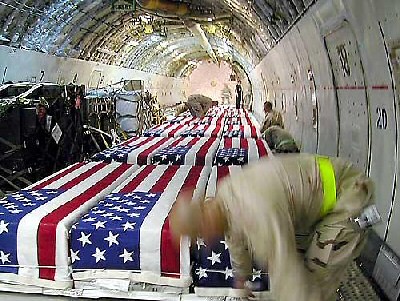
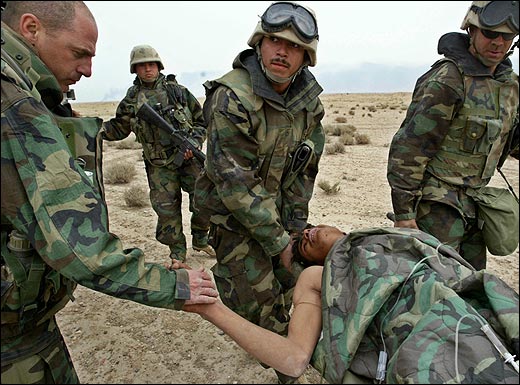
We won this election in 2006 because Americans were tired of seeing these pictures. We can't let those voters down. We can't accept this ludicrous idea from the Iraq Study Group or the Joint Chiefs or John McCain that if we just send more troops, we can win this. There is no definition of victory. There is no meaning to the word "win" here. If we continue to send our troops into the middle of this fight, we will only see more bloodshed. The smartest strategy here is to keep this situation contained, but to withdraw largely from the center of it. We can prevent this civil war from becoming an international headache, but we shouldn't spare another American soldier to make the Sunnis and Shia play nice.
In 2008, I'd like us to have a Presidential nominee who had the good sense to judge this war a mistake from the beginning. Being President of the United States is not something anyone can truly prepare for, but having good judgment on this war is a critical prerequisite for me. Senator Obama and Vice President Gore are the only two possible candidates who opposed this war from the beginning. If Senator Obama does not get in (I hope he does, and Gore is a pipedream to get in), I will have to choose who among the remaining candidates has the greatest judgment on this war, but it will not be easy. Senator Obama should get in, because he is the right person with the right judgment to be President of the United States at this time.
Now, here is what Hell on Earth looks like.








I know what you thought when you read that: “But I thought the children were our future!?”
True enough.
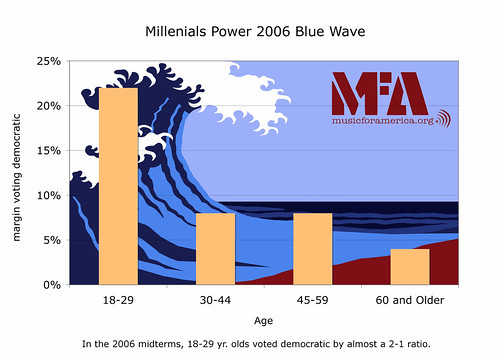
Youth turnout this November was the highest it has been in twenty years, and it favored Democrats by a whopping 22 percent margin (60% to 38%). This is more than twice as favorable as any other age group.
People associate with a political party in their youth, and it usually sticks. Those who came of age during FDR’s (prolonged) tenure became New Deal Democrats. Many voters from Reagan’s era – now in their 40s or 50s – are reliably Republican. Bush seems to be having a similar effect, except he is driving people away from his party. Our generation is becoming politically conscience in the era of 9/11, Katrina, and Iraq, and the Republican Party is suffering for it.
Young voters believe that America is on the “wrong track” by a ratio of three-to-one.
In nine years, our generation will comprise a third of the total electorate.
The future looks bright. Pun intended.
What makes us Democrats?
What makes them Republicans?
It's a fascinating question. Some argue that our socialization as children by our parents shapes our partisan affiliation. And certainly, this is part of it. But there are those who buck their parents and those who change party affiliation over their lifetime.
So for those of us who have been Democrats all of our lives and would rather move to China than become Republicans, what makes us fundamentally Democrats?
Yes, we support Democratic policies over Republican ones. And we may even support our candidates more because they're just better people.
We support raising the minimum wage, getting everyone health care, supporting better education, protecting the environment, supporting civil and equal rights, preserving our Constitutional liberties, building alliances and pursuing diplomacy outside our borders. But what joins these ideas? What is our Democratic philosophy that makes us believe in these policies?
I believe that we Democrats believe in two fundamental ideas. The first is the idea of the American Dream. We Democrats believe that at the very core of America lies an idea that if you are a good person, you help others, you work hard, and you play by the rules, it doesn't matter what your race, religion, sexual orientation, nationality, age, or disability is, but you too, in this great, meritocratic, tolerant, generous, and forgiving society that is America, can succeed and give your children better than what you had. This fundamental idea is why we Democrats support a better education, health care for all, support immigrants, want to promote tolerance, respect, and diversity, oppose poverty, and want everyone to have a good-paying job.
The second idea in which we fundamentally believe is the Constitution. To us Democrats, we view this document as a sacred scroll, one that provides us with guidance, directs our moral compass, and provides a framework for how we interact with our fellow citizens in society. We take that preamble seriously, and believe in "form[ing] a more perfect union." We believe in that Bill of Rights, that tell us that generally people can say or practice or express whatever they want, unless they are harming someone else, without any interference from the government, and beyond that, with a great deal of respect and healthy discourse from those that oppose your ideas. This constitution, for which we as Democrats dedicate ourselves, charges us with a civic duty to protect the foundational ideas of our country from radical change from any ideology.
And what do the Republicans believe? I believe, and I can't say for sure because I am not a Republican, that they also support two fundamental ideas as well. Those two ideas are the free market and the Bible. Republicans fundamentally believe in the greatness of the free market and the power it possesses, which leads them to mistrust any government intervention in the economy, through taxes, regulations, or spending. But this idea of the free market extends to social life as well, and tells them that diversity, tolerance, and respect must be met by the forces of social supply and demand, and government should not try to promote liberty and tolerance in places where the political and social marketplace won't accept it. When you tie this belief to a fundamental belief in the divinity and infallibility of the Bible, you get a Republican who believes that the word of Adam Smith and God are the will that they must follow. Their mindset is a core adherence to these principles.
Now I am not trying to say that Republicans don't also support the American Dream and the Constitution. They surely do. And Democrats certainly take the free market and the Bible extremely seriously and follow them too. But the priority of Democrats is to follow the Constitution over the Bible in our political lives, and we believe fundamentally that the free market is a means to the American Dream, not the other way around.
What do you guys think?
If you’ve walked through Red Square recently, you may have noticed flyers promoting the Georgetown chapter of America’s newest third party campaign, Unity ’08. Founded by former advisors to the Ford and Carter administrations and Maine’s former Independent governor Angus King, intends to run a third ticket in the upcoming presidential campaign, featuring a split ticket, or possible independents
Unity 08 is based on the conviction that the two major parties are corrupt, slaves to special interest dollars, and driven to extremism by the influence of their respective bases. The result: American government is paralyzed by partisanship, essentially ignoring the beliefs and issues that matter to the moderate majority of the nation.
Encouraged by the immense potential of the internet for grassroots mobilization, the campaign intends to hold a nominating convention online in early 2008 to select its ticket. The ‘primary’ will be open to all American voters. Although no one has officially declared candidacy yet, some names being thrown around include Sen. Lieberman, Rudy Guliani, Chuck Hagel, Michael Bloomberg, Mark Warner, Wes Clark, and—implausibly enough—John McCain, whom the media still insists on calling a moderate.
If Unity 08 supporters think that the government is unproductive now, they should wait until they put a split ticket in office. The last time this happened, during the election of 1796, which resulted in a Federalist President (Adams) and a Democratic-Republican VP (Jefferson), strife within the executive branch was disastrous, resulting in the 12th Amendment which ensured that such a situation wouldn’t occur again. Furthermore, they assume that there is some sort of parity between the two positions, which is obviously part of the truth. Unless two independents are nominated, the Unity ticket will inevitably represent the moderate wing of one of the two major parties.
Despite their claim that they represent the centrist majority of Americans, like all third parties in America’s winner-take-all electoral system, the Unity 08 ticket will, at most, play the role of spoiler (Perot in ’92, Nader in ’00, etc). Given its reformist mentality, general idealism, and emphasis on corruption, climate change, and dependence on foreign oil, it’s a safe bet to say that Unity will siphon most of its votes from the Democrats.
This is particularly evident when you consider that the controversial social issues it avoids addressing—abortion, gay marriage, and gun control, for example—are powerful wedge issues which drive Republicans, more than Democrats, to the polls.
Loyal Democrats have no reason to fear, however—the Unity ticket is destined to play a minor role, if any at all, in 2008. Decrying the role that special interests play in electoral politics, Unity plans to run solely with private donations. The problem with this plan, though, is that moderates, lacking a strong ideological drive, are the least likely to donate.
Furthermore, while Americans and the media repeatedly disparage the politics of negativity and personal attacks, calling for a more substantive debate, they repeatedly reward these tactics at the voting booth.
Another problem with running an issue-based campaign is that Unity 08 doesn’t actually have concrete positions on them. Sure, they call for bipartisanship and attention to the ‘crucial issues’, but they don’t actually take a stand on any of them. Appealing to disillusioned, generally apathetic voters, Unity 08’s central platform seems to ask: Can’t we all just get along?
No.
We can’t.
Despite its trivial nature, politics deals with serious issues which many Americans passionately disagree on and cannot simply be ignored. It is a forum where people of different philosophies wage ideological warfare, and the means through which our nation comes to a consensus on its core values and priorities. Perhaps this is just the viewpoint of one bitter partisan, but I don’t see anything admirable about conciliatory centrism, particularly when the decisions of our government can mean the difference between life and death.
Our government is far from being truly democratic, and elections are often determined by the most superficial aspects of politics, a vague, warm-and-fuzzy call for harmony is no solution. Yet, while it is easy and fashionable to spout clichés criticizing partisanship, negative campaigns, the overwhelming advantage of incumbency, and the inevitable influence of money on government, it is much harder to come up with constructive policies to improve health care & education, reduce the budget deficit, and make our democracy more representative. It’s even more difficult to do so without disagreement.
One of the reasons that money, incumbency, and superficiality frequently carries the day in politics is because so many people buy into the ignorant maxim, spouted by naysayers such as the Unity 08 crowd, that there’s no difference between the two major parties. Instead of issuing fruitless calls for unity and adding to the unproductive chorus of discontent, they should help voters see past the mudslinging by showing apathetic Americans that despite the medium, the government matters.
As a fellow partisan once said, “Moderation in the pursuit of justice is no virtue.”
I'm going to go ahead and ramble on about Dean and his 50 State Plan again...
Sure, I am no Deaniac, but his 50-state plan is great (don't get me wrong, I love the Ragin' Cajun as much as anyone...). Reading DailyKos today allows me to remind you how important it is to keep Dean and how we lost the South in the first place. This is what not to do now:
"Now, this doesn't mean we need to abandon the South, belittle the South, mock the South, piss on the South, or ignore the South. A national party with a real mandate needs to be competitive in every corner of our great nation."
He's exactly right. I read What's the Matter with Kansas and hated it. But, I am (sort of) from the South and I understand exactly what Kos and Thomas Frank are saying. The people of the South have been mislead, just as much of the Midwest had been, by Republicans but the Democrats need only to step in. The South was written off bu all of us, especially after '04 with the maps detailing "JesusLand" (http://www.basetree.com/graphics/jesusland.jpg) as everything that was not California, New York, and Hawaii. If I considered myself a true Southerner and planned on living in the South forever, I would have become enraged and voted with the party that was accepting me. Clearly the left wanted nothing to do with the South!
Coming from Northern Kentucky, where a Democrat 2-term incumbent couldn't beat a one-term, Republican party liner, George Bush lover to win his Congressional seat back, I could very much say "Write it off, the South is done! It's finally over", but the Democratic party can not. This year, we picked up seats in the South, which should tell us that these people are just looking for the quality candidates they have not gotten in years. We finally have a chance to encourage good Democratic candidates to run and bring the South to the good side. Let's keep putting money (and faith) behind these Dems in the South and they might just win.
